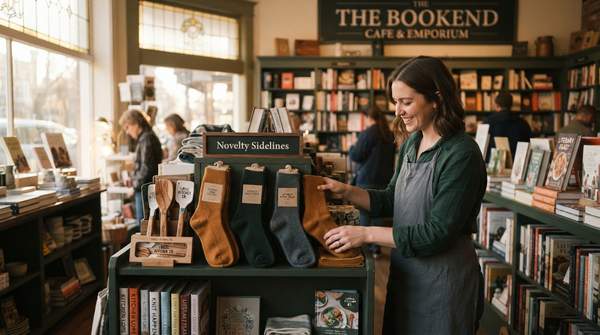
When you spot a pair of "literary socks" printed with famous author quotes next to the fiction table, or cooking utensils shelved beside the cookbooks, you are not looking at random merchandise. Independent bookstores deliberately stock these non-book items—known in the trade as "sidelines"—to extend their inventory and deepen the shopping experience. But the move carries a real risk: stock the wrong mix, and a bookstore starts to look like just another gift shop. A Harvard Business School working paper on bookstore strategy describes exactly this tension, and it is worth understanding as a shopper, because it explains why the items on those shelves are deliberate business decisions.
More Than Books: The Strategic Role of 'Sidelines'
Sidelines are non-book products that a bookstore curates alongside its titles. The Harvard Business School analysis, which draws on interviews with booksellers and real estate developers, frames them as a tool for extending a store's book inventory into related products rather than replacing it. The examples the paper highlights are telling: memorabilia such as t-shirts and "literary socks" featuring references to famous authors or quotes, which appeal to passionate readers, and bundled offerings like cooking utensils placed in a cookbook section.
What makes sidelines strategic rather than incidental is the curation behind them. Booksellers, according to the paper, carefully select which sidelines to carry specifically to mitigate the risk of being perceived as just another gift store. That is a striking admission: the merchandise is chosen as much for what it prevents—a generic gift-shop image—as for what it adds. Finding the right mix of books and sidelines is described as genuinely difficult, and booksellers report the importance of not overextending sidelines, at the risk of tarnishing what makes their store unique.
Extending the Literary Experience: Inventory and Complementary Products
The first strategic pillar is what you might call inventory extension. The idea is simple: a reader who comes in for a cookbook may also need the tools to cook from it, so placing utensils in the cookbook section turns one purchase into a coherent experience. The Harvard paper cites this bundling of books with sidelines as an approach that has proved effective.
Literary-themed memorabilia works the same way, but on the identity side of the ledger. Socks printed with an author's quotes or a t-shirt referencing a beloved novel are not practical complements to a specific title—they are expressions of reader identity. The paper notes these items appeal to passionate readers, which means they deepen the store's connection to its core customers rather than reaching for an entirely different audience. That distinction matters: sidelines succeed when they grow out of the store's literary mission, not when they pull the store away from it.
Cultivating Community: Bookstores as 'Anchors of Authenticity'
The second pillar is experience enhancement, and it connects to a bigger shift in retail. According to interviews with prominent real estate developers cited in the Harvard working paper, independent retailers are increasingly becoming "anchors of authenticity"—shopping destinations consumers visit in search of a unique experience that a big-box chain cannot replicate. As shopping malls close, developers are actively looking for exactly this kind of tenant to draw people back to brick-and-mortar locations.
The paper's bookstore example makes the concept concrete: a reader might choose a shopping location specifically to spend the afternoon reading at an independent bookstore café and then shop at several nearby local businesses. The bookstore becomes the reason the trip happens. Curated sidelines feed this role by making the store feel like a place with a distinct character rather than a catalog.
Writing for the audiobook platform Libro.fm, Zakiya Jamal captures the consumer side of this: scrolling through books on a website is not the same as walking through a bookstore and picking up whatever catches your eye, and that distinct character is something online shopping cannot match. A bookseller-focused article by Demetrius Frazier at Resist Booksellers adds that independent bookstores provide handpicked selections reflecting the tastes and values of their communities, alongside events that transform a store into a cultural hotspot and foster a sense of belonging. Sidelines are part of that handpicked character.
The Bookstore's Strategic Sidelines: A Balancing Act
Here is a framework for reading the non-book items you encounter, built from the Harvard analysis. It separates the two strategic pillars sidelines serve, then maps the shared risk that makes curation so demanding.
| Strategic pillar | What it looks like | Item examples from the evidence | Impact on identity | Risk if misaligned |
|---|---|---|---|---|
| Inventory Extension | Sidelines that complement specific book categories, often bundled with them | Cooking utensils placed in a bookstore's cookbook section | Deepens the core book-selling mission; one visit becomes a fuller experience | Overextending sidelines can tarnish what makes the store unique |
| Experience Enhancement | Sidelines that express reader identity and make the store a destination | Literary memorabilia: t-shirts and "literary socks" with author references or quotes | Supports the store's role as an "anchor of authenticity" that draws consumers to brick-and-mortar retail | Poor curation risks the store being perceived as just another gift store |
The reasoning path is straightforward. Both pillars point toward the same overarching goal—making the bookstore a unique destination—but they fail in the same way if the curation slips. A spatula beside the cookbooks extends the literary experience; a wall of unrelated trinkets replaces it. The Harvard paper's booksellers describe optimizing that mix as difficult precisely because the line between extension and dilution is fine, and the store's identity is what is at stake.
The Strategic Tightrope: Balancing Identity and Diversification
Why does this balance matter so much? Because the bookstore's identity is its competitive asset. The "anchor of authenticity" role that real estate developers now prize exists only as long as the store remains unmistakably a bookstore. The Harvard analysis is explicit that maintaining a clear bookstore identity is crucial for long-term strategic success, and that booksellers themselves report the danger of overextending sidelines.
There is also a collective dimension. The paper quotes Oren Teicher, then the outgoing CEO of the American Booksellers Association, on how the trade group has institutionalized shared values among booksellers while allowing each local store to keep its own unique identity. Sidelines fit into that picture: they are one of the most visible ways an individual store expresses its particular character within a shared professional identity.
One honest limitation: the available analysis does not include financial data on how profitable sidelines are compared with books, so this article sticks to the strategic logic rather than the margins. And the analysis covers independent bookstores specifically—not the diversification strategies of large chains.
Shopping with Purpose: Recognizing the Bookstore's Strategy
When visiting an independent bookstore, shoppers can look for non-book items that either directly complement literary themes or reflect local community values, understanding these are deliberate choices to enhance the store's unique identity. The measurable indicator is the presence of non-book items that clearly align with literary themes, local culture, or the store's specific curatorial aesthetic, rather than generic merchandise. If the socks quote an author and the utensils sit beside the cookbooks, you are watching the strategy work. If the shelves could belong to any gift shop, the tightrope has slipped—and that tells you something about the store's next chapter.