Independent bookstores survive—and thrive—not by out-pricing Amazon, but by doing three things the online giants cannot: building community, curating a distinctive selection, and convening people face to face. That is the core finding of Harvard Business School research on why indie bookstores rebounded despite the rise of "the everything store." Once you know this "3 Cs" framework, you can walk into almost any local shop and recognize the deliberate strategy behind its shelves, its sidelines, and its packed event calendar.
The Resurgence of Independent Bookstores: The '3 Cs' Framework
Harvard Business School researcher Ryan Raffaelli studied how independent bookstores won customers back from Amazon, Borders, and other big players, and identified three pillars behind their resurgence: Community, Curation, and Convening. The study's central insight is that indie booksellers compete on customer experience, not price or inventory. Rather than fighting a losing battle over discounts and unlimited stock, successful stores repositioned themselves as local institutions offering something an algorithm can't deliver. The framework applies to the U.S. market as described in that research, and it explains the specific features you'll notice in stores near you—from local-author shelves to game nights.
Community: Anchoring Localism and Shared Values
The first pillar is localism. According to the Harvard research, independent booksellers were among the first to champion the idea that consumers should support their local communities by shopping at neighborhood businesses, and they won customers back by stressing a strong connection to local community values. That localism is more than a marketing slogan—it defines what the store stocks and whom it serves. Writing in the Stanford Social Innovation Review, Barbara Wheeler and William Ames describe how Emerson Collective began researching the value independent bookstores bring to their communities during pandemic lockdowns, finding promising experimentation already underway.
Practitioner accounts echo the same theme: many stores operate as "nerve centers" for a community, a literary watercooler where browsing slowly and chatting with neighbors is encouraged. When you see a store promoting neighborhood businesses or hosting local groups, you're watching the first C at work.
Curation: Crafting a Unique and Personalized Selection
Curation is the bookstore's answer to infinite inventory. The Harvard study found that booksellers curate collections to combat the paralysis shoppers face when confronting Amazon's seemingly unlimited catalog. In practice, that means stocking titles chosen for a specific place and its people—for example, a Montpelier, Vermont store featuring books on foraging for local mushrooms, or showcasing homegrown authors in a regional section. It also means personal relationships: rather than only recommending bestsellers, booksellers help customers discover up-and-coming authors and unexpected titles. As one publisher's account puts it, human recommendations come from real conversations, not algorithms, and shelves reflect care, intention, and a deep understanding of readers. A store's carefully selected children's or teen collections, which booksellers credit with sparking lifelong learning, are part of the same deliberate craft.
Beyond Books: The Strategic Role of Sideline Products
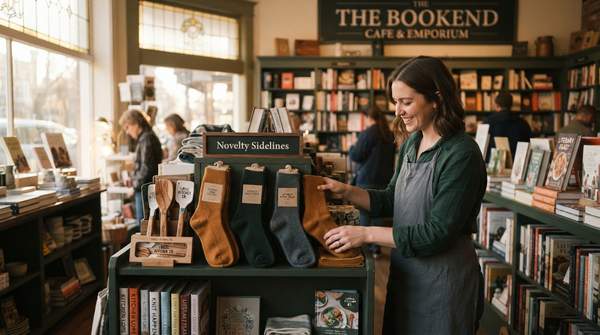
Look around a well-run indie and you'll notice more than books: stationery, cards, tote bags, "literary socks" printed with famous author quotes, even cooking utensils beside the cookbooks. The Harvard research describes these "sidelines" as deliberate extensions of the book inventory—memorabilia appeals to passionate readers, and bundling books with related products has proved effective. Marketing analysis of indie bookstores notes that since they couldn't compete on price, they built an ecosystem around books to retain customers and add value. The financial stakes are real: industry data cited by retail writer Kenneth Rodriguez indicates that strong sideline programs can contribute as much as 25% of total sales.
But the Harvard study also flags the trade-off—booksellers carefully curate sidelines to avoid being perceived as just another gift store, and report the importance of not overextending, at the risk of tarnishing what makes them unique.
Convening: Creating Spaces for Connection and Events
The third pillar turns the store into a gathering place. The Harvard research found that indie booksellers promote their shops as intellectual centers for convening customers with like-minded interests—offering lectures, book signings, game nights, children's story times, young adult reading groups, and even birthday parties. Raffaelli notes that some bookstores now host over 500 events a year that bring people together. Supporting that effort, the American Booksellers Association, a nonprofit trade association, has done top-down work to promote independent bookstores nationally. The payoff for readers is what publishers describe as spaces for discovery, connection, and thoughtful conversation—where books are shared through relationships, not just transactions. A store's event calendar is often the clearest window into its community role.
The '3 Cs' Framework for Independent Bookstore Success
Use this diagnostic framework to deconstruct your local store's strategy. For each pillar, check what the store actually does—then you'll see how inventory choices, events, and local partnerships work together to build a community hub.
| Pillar | What it means | What to look for in the store | What you get |
|---|---|---|---|
| Community (Localism) | Champions shopping at neighborhood businesses; anchors itself in local values. | Local-author sections, regional titles, promotion of nearby businesses, space to linger and talk. | A "third place" for connection and a store tied to where you live. |
| Curation (Specialized Selection) | Personal, specialized inventory chosen to cut through Amazon's unlimited catalog. | Homegrown authors, geography-specific titles, sidelines like literary socks or utensils bundled with cookbooks. | Human recommendations and discoveries an algorithm won't surface. |
| Convening (Events & Gatherings) | Promotes the store as an intellectual center for like-minded customers. | Lectures, book signings, game nights, story times, YA reading groups, birthday parties—some stores host 500+ events a year. | Shared cultural experiences and thoughtful conversation. |
Reading the table as a checklist is the point: a store that scores on all three pillars isn't accidentally charming—it is executing a documented strategy. Note the balance test, too. If the sidelines dominate the books, the store may be drifting from the curation identity the research says makes indies distinctive.
Supporting Your Local Independent Bookstore
To effectively support local independent bookstores, focus on engaging with their community programs, appreciating their curated selections, and participating in their convening events. Concretely: buy the local-author title instead of the one-day-shipped bestseller, ask a bookseller for a personal recommendation, and put a store event on your calendar this month. The measurable indicator of success is increased participation in store events, positive feedback on curated selections, and a growing sense of local connection—signs you can observe directly in attendance, staff conversations, and the store's role in your neighborhood.
Sources
- How Independent Bookstores Have Thrived in Spite of Amazon.com — Harvard Business School
- Sustaining Independent Bookstores (SSIR)
- Why Independent Bookstores Still Matter — New Harbinger Publications, Inc
- Marketing like an Independent Bookstore — Ooligan Press
- \r\n \n Why Independent Booksellers Are Vital to Local Communities\n \r\n — Lionessbookstx