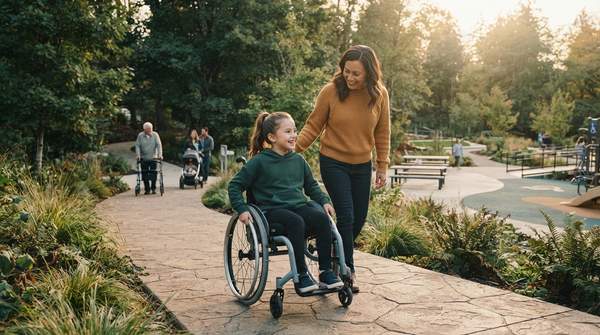
A park becomes genuinely accessible when it works for a visitor who uses a wheelchair, a child who covers her ears in the wind, and a family that needs to know trail conditions before leaving home—all at the same time. That standard goes well beyond a ramp at the entrance. Accessibility today spans physical infrastructure like smooth trails and handrails, adaptive equipment such as all-terrain wheelchairs, sensory elements like braille signage and inclusive playgrounds, and the everyday amenities—restrooms, benches, clear maps—that determine whether a visit lasts an hour or an afternoon. Here is how those pieces fit together, and how to evaluate any local park against them.
Understanding Park Accessibility: Beyond Basic Compliance
The foundational idea is inclusion: the National Recreation and Park Association's 2017 "Parks for Inclusion" initiative defined it as "removing barriers, both physical and theoretical, so that all people have an equal opportunity to enjoy the benefits of parks and recreation." That framing, highlighted by George Mason University's College of Education and Human Development, treats accessibility as a matter of equal opportunity rather than a checklist of minimum dimensions.
Research bears out why the distinction matters. A statewide assessment of public park accessibility and usability published in the National Library of Medicine found that trails may meet basic dimensional standards, such as width, yet still fall short on practical usability for many users, particularly individuals with mobility disabilities. The same study found that communication and wayfinding supports were limited across settings, and it concluded that independent use of parks and playgrounds depends not on individual features alone but on how multiple environmental elements function together.
Writing for the Children & Nature Network, Mark Davison makes a related point from a parent's perspective: the absence of a diverse sensory focus in ADA regulations, he argues, hinders the creation of emotionally stimulating experiences, "to the detriment of all." The lesson for visitors is that a park can be technically compliant and still present real barriers.
Key Features for Mobility Access
The most visible accessibility work addresses physical barriers. The Wilderness Society identifies uneven terrain, steep inclines, and a lack of ramps or handrails as among the obstacles people with disabilities most often encounter in outdoor environments like parks and trails. Removing those barriers means paved or firm, smooth surfaces; gentle grades; ramps where level changes occur; and handrails where stability matters.
Adaptive equipment extends that access beyond the pavement. The National Park Service announced that all-terrain wheelchairs are now available at Zion, Bryce Canyon, Arches, Canyonlands, and Capitol Reef national parks, according to an announcement from Extreme Motus, the Utah-based manufacturer of the off-road chairs. That program gives visitors with mobility limitations new opportunities to experience rugged, iconic landscapes that a standard wheelchair could not manage—and it reflects a growing movement to make outdoor recreation more accessible nationwide. The Wilderness Society likewise notes that parks can make it easier to rent wheelchairs as part of broader recreational programming.
Inclusive Play and Sensory Experiences
Playgrounds are where accessibility design gets most creative. Inclusive play areas, as Davison describes them, utilize the concept of Universal Design to promote play among children of differing abilities, ages, and levels of confidence or skill. Rather than isolating an accessible swing or ramp in one corner, universal design integrates accessible equipment throughout the space and often weaves in nature play.
Sensory considerations matter for adults as much as children. The Wilderness Society recommends that maps and signage be designed with accessibility in mind, including features like braille, large-print text, and audio recordings, and that guided tours and other programming be planned to cater to different abilities. Davison's vision goes further: infrastructure that engages the full array of senses, promoting diverse experiences and a richer universal outdoor experience for all children—not just meeting a regulatory floor.
Essential Amenities and Wayfinding
Even a park with excellent trails fails visitors if the supporting amenities fall short. Accessible restrooms and changing facilities support personal care needs across a diverse range of visitors, while accessible picnic areas and benches provide crucial resting points and social spaces that make longer, more comfortable visits possible.
Information is an amenity, too. The Wilderness Society argues that parks should tell visitors what they will find before they arrive—the width, slope, and condition of surfaces—because it isn't enough just to label certain trails "accessible." Those details need to be widely available, including via accessibly designed websites. On-site, the same principle applies: signage, maps, and audio supports should let a visitor plan a route that matches their abilities rather than discovering barriers mid-visit.
Your Park Accessibility Checklist
Use this framework on your next visit to score a park across four dimensions. Mark each item yes, partial, or no, then look at the pattern rather than any single answer—remember, usability depends on how the elements work together.
| Dimension | What to Look For | Why It Matters |
|---|---|---|
| Mobility Access | Firm, smooth trail surfaces; gentle grades; ramps and handrails at level changes | Uneven terrain, steep inclines, and missing ramps are the most common outdoor obstacles |
| Adaptive Equipment | Wheelchair rentals or loan programs; all-terrain chairs for rugged areas | Extends access to natural terrain a standard wheelchair cannot manage |
| Sensory & Cognitive Support | Braille, large-print, and audio signage; inclusive playground equipment integrated throughout; sensory-friendly programming | Universal design engages differing abilities, ages, and confidence levels |
| Essential Amenities | Accessible restrooms and changing facilities; accessible picnic tables and benches; pre-visit trail details (width, slope, condition) online | Resting points and personal-care facilities determine visit length and independence |
A "partial" on trail dimensions is worth probing: a path may meet width standards yet still be too rough or steep for independent use, exactly the gap the statewide assessment documented. A "no" on pre-visit information is one of the easiest gaps for a park to fix, and a reasonable thing to raise with park staff.
Making Parks Truly Accessible: A Continuous Commitment
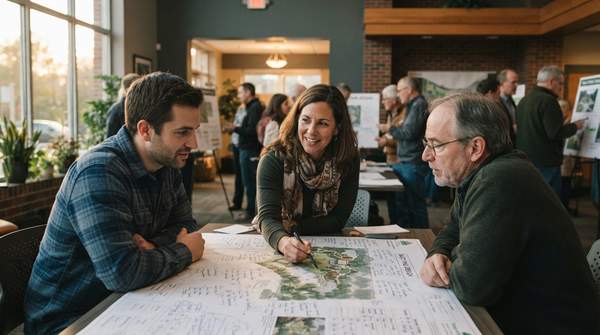
Visitors can effectively assess park accessibility by using a comprehensive checklist that considers not only basic ADA compliance but also practical usability, sensory inclusion, and adaptive equipment. The deeper principle is collaboration: The Wilderness Society emphasizes that enhancing accessibility on public lands requires government agencies, park officials, policymakers, disability advocacy organizations, and people with disabilities working together—with people with disabilities at the center of planning, staff training, and programming decisions.
Watch for measurable progress in your own community: an increase in parks adopting universal design principles and providing clear, multi-modal wayfinding information is the concrete indicator that a park system is moving from minimum compliance toward genuine inclusion. Availability of specific features will vary by park, municipality, and funding, so treat your checklist results as a starting point for conversations with park staff rather than a final verdict.
Sources
- Accessibility and Inclusion in Parks — CEHD
- Statewide Assessment of Public Park Accessibility and Usability and Playground Safety - PMC
- Inclusive park spaces for children with disabilities — Children & Nature Network
- 5 ways to make the outdoors more accessible for people with disabilities — The Wilderness Society
- Utah-Based Extreme Motus Expands Outdoor Accessibility as All-Terrain Wheelchairs Become Available at… — Prnewswire