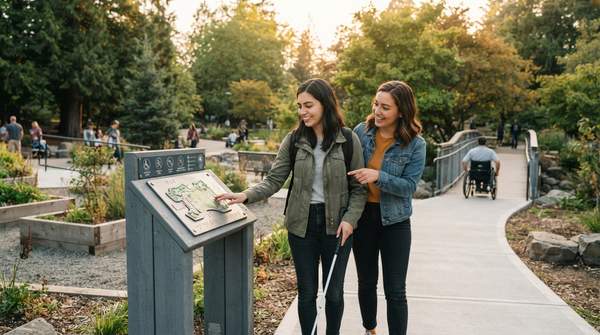
When you walk into a park that has been thoughtfully designed, the accessibility work is often invisible: a smooth path simply continues where a curb used to be, and a swing with a high back just looks like another swing. But each of those choices answers a specific need. Accessibility experts generally group park features into three categories—physical, sensory, and cognitive—and understanding which features serve which needs turns a casual visit into an informed one. This guide breaks down what to look for, why it exists, and how to tell a park that merely complies with minimum standards from one that genuinely welcomes everyone.
Understanding Park Accessibility: Beyond Basic Compliance
The Oxford Review's briefing on accessibility in public spaces defines the three pillars clearly. Physical accessibility covers features such as ramps, lifts, widened doorways, and tactile paving that let people with mobility impairments navigate independently. Sensory accessibility asks a space to serve people with visual or hearing impairments through features like Braille signage, audio descriptions, and visual alarms. Cognitive accessibility means designing with clarity and simplicity—plain-language signage, uncluttered layouts, and alternative formats for information—so that people with cognitive disabilities can use the space without confusion.
These categories are not competing priorities; they overlap in a single park. A paved pathway serves a wheelchair user and a parent pushing a stroller equally. A sensory garden delights a child with sensory processing differences and a grandparent who simply enjoys fragrant plants. That breadth is the point: good accessible design tends to improve the park for everyone who visits.
Physical Accessibility: Navigating Parks with Ease
Physical access begins before the playground equipment. The U.S. Access Board's guide to play area accessibility establishes minimum requirements for newly constructed and altered play areas, emphasizing that children with disabilities should be able to reach the diversity of play components a space offers—not just one token piece of equipment. Its guidelines address accessible routes connecting play components, along with the spaces that make a play area genuinely usable.
In practice, that means ramps and handrails at entrances and pathways, as the Oxford Review's park renovation example describes, so wheelchair users can move through the park easily. It also means the connective tissue between features: a case study in the Rick Hansen Foundation's guide to creating accessible play spaces describes a school community whose "must-have list" included making sure all play areas were connected with paved pathways. Accessible parking and restroom facilities matter too, as Playworld's guide to inclusive parks notes—accessible parking helps people who must drive to reach the park, and accessible restrooms let visitors stay longer rather than cut a visit short.
Sensory Accessibility: Engaging All Senses
Sensory features do two different jobs, and it helps to keep them distinct. The first is enrichment: creating experiences that engage the senses. The National Center on Health, Physical Activity and Disability (NCHPAD) notes that beyond ramps, accessible swings, and play panels, an inclusive playground may feature sensory walls, quiet sensory gardens, water play, or splash pads. Playworld's guide adds that many tactile and musical elements don't require safety surfacing and can sit along paths, making them reachable for kids of all ability levels.
The second job is information access. Braille signage with tactile maps at key locations, as described in the Oxford Review's park example, helps visitors with visual impairments find their way and understand the park's layout. Sensory gardens with aromatic plants and textured surfaces can serve both purposes at once—offering a multisensory experience to visitors with sensory sensitivities while giving every guest something richer than grass and mulch.
Cognitive Accessibility: Clear and Intuitive Experiences
Cognitive accessibility is the quietest of the three categories, but it shapes whether a visitor feels oriented or overwhelmed. Plain-language signage, uncluttered layouts, and simplified information—as the Oxford Review puts it, designing "with clarity and simplicity"—help people with cognitive disabilities navigate independently and with less anxiety.
Designers have found concrete ways to build this clarity in. The Rick Hansen Foundation case study describes a park that added barrier-free surfacing with color highlights to guide children toward different play features and to mark equipment transfer points. The same project added playground equipment chosen to develop skills through sensory, mobility, and cognitive play experiences—recognizing that play itself can be structured to support different learning styles rather than only physical development.
Accessible Park Features by Need and Benefit
The table below organizes common park features by the primary need each one serves, so you can scan for what matters to you or your family and understand the purpose behind the design.
| Accessibility Need | Example Park Features | How It Helps |
|---|---|---|
| Physical — mobility and navigation | Ramps and handrails; paved pathways connecting play areas; widened entrances | Lets wheelchair users and people with mobility aids move independently through the whole park, reaching every area and amenity rather than a segregated section |
| Physical — arrival and duration | Accessible parking; accessible restrooms | Ensures people who drive or use transit can reach the park, and lets visitors stay as long as they like |
| Sensory — engagement | Sensory gardens with aromatic plants and textured surfaces; sensory walls; musical and tactile elements along paths; water play | Provides varied sensory input that visitors with sensory sensitivities can enjoy, placed where children of any ability level can reach them |
| Sensory — information access | Braille signage; tactile maps at key locations | Enables visitors with visual impairments to wayfind and understand the park's layout on their own |
| Cognitive — navigation | Plain-language signage; clear, uncluttered layouts; color highlights in surfacing that guide children to play features | Reduces confusion and anxiety, supporting independent movement and a sense of security |
| Cognitive — play | Equipment chosen for cognitive play experiences, such as skill-building and interactive components | Fosters engagement and development for children with diverse cognitive needs and learning styles |
What Makes a Playground Truly Inclusive?
Here is where many parks fall short, and where the distinction matters most. NCHPAD puts it bluntly: "While an ADA-compliant playground is not necessarily accessible, and inclusive playground takes into account physical, intellectual and sensory disabilities." Compliance sets a floor; inclusivity is a philosophy that children and adults of all abilities benefit from playing and interacting together.
Playworld's guide draws the same line from the other direction: a park that is not accessible at all cannot be inclusive, but separate entrances or play areas reserved for wheelchair users are not inclusive either, because they exclude people with other physical and mental abilities. For a park to be inclusive, everyone needs equitable access to the amenities—not a special area beside the main one.
The framework designers use to get there is the Principles of Universal Design, which NCHPAD outlines:
| Principle | What It Means for a Park |
|---|---|
| Equitable Use | The design is useful to people with diverse abilities—not separate or stigmatizing |
| Flexibility in Use | It accommodates a wide range of preferences and abilities |
| Simple and Intuitive Use | It's easy to understand regardless of experience, knowledge, language skills, or concentration level |
| Perceptible Information | Necessary information is communicated effectively regardless of ambient conditions or sensory abilities |
| Tolerance for Error | It minimizes hazards and the consequences of accidental or unintended actions |
| Low Physical Effort | It can be used comfortably, efficiently, and with minimum fatigue |
| Size and Space for Approach and Use | Appropriate size and space allow approach, reach, and use regardless of body size, posture, or mobility |
The Access Board itself encourages designers to exceed its minimum guidelines where possible to provide increased accessibility and opportunities. The Rick Hansen Foundation case study shows what that looks like: a school community that raised $350,000 for a playground reflecting Universal Design principles, so that everyone could play.
Choosing Parks for Inclusive Recreation
When evaluating a park for its accessibility, look beyond basic compliance to identify features that actively support physical, sensory, and cognitive needs, reflecting the principles of Universal Design. A park that meets only the minimum may have an accessible entrance but leave the rest of the experience fragmented.
The measurable indicator to look for: the presence of diverse play equipment, multi-sensory elements, clear wayfinding, and seamless pathways connecting all areas indicates a truly inclusive park. If you can trace a smooth route from parking to restroom to every play area, read the signs without guessing, and find something engaging for a child with any mix of abilities—physical, sensory, or cognitive—you've found a park designed around people rather than around a checklist.
Sources
- Accessibility in Public Spaces - Definition and Explanation — The Oxford Review - OR Briefings
- ACCESS BOARD
- Rickhansen
- How to Start an Inclusive Park — Playworld
- Discover Inclusive Playgrounds — National Center on Health, Physical Activity and Disability (NCHPAD)