Every indoor vine makes one fundamental choice before you buy it: grow upward or spill downward. That single habit determines your display method, your maintenance effort, and the look you get. Here is how to choose wisely.
Climbing vs. Trailing: Choosing Your Vining Plant's Growth Habit
Vining houseplants grow in two distinct ways. Climbers reach upward, and with guidance they can cover a wall, pole, or trellis. Trailers cascade downward from their containers, creating a soft curtain of foliage.
The key to a successful climber, according to the growing team at Ted Lare's garden operation, is to train it young. Guiding a plant into an upright habit early helps it keep growing that way for life. Trailers need no such intervention — hanging growth is their natural pattern when they lack vertical support.
The choice is really about you and your room:
- Pick a climber if you have empty vertical space — a plain wall, a corner, a window frame — and you're willing to attach supports and guide stems.
- Pick a trailer if you have a shelf, mantel, or ceiling spot and want a cascading effect with minimal hands-on training.
Note: a trailer won't hold itself up. Interior designer Vickie Greene's advice about pothos, reported by Yahoo Shopping, points out that its stems grow downward and cannot hold themselves up — so if you want them to climb over a picture frame or stair railing, you have to guide them yourself.
Displaying Climbing Vines: Vertical Greenery and Structured Growth
Climbers deliver the drama — a living green wall, a vertical garden. But they don't get there alone.
Gardenista's houseplant writer Jane Perrone is direct about this: if you prefer your vines to climb, most — with the exception of the true vines — will need some help to cling. Her recommended method is tying vines to a moss or coir pole, which has a bonus benefit of keeping humidity-loving plants happy.
Your vertical toolkit:
- Moss or coir poles: tie stems gently to the pole as they grow; the classic support for vertical growth.
- Wall trellises and hooks: Sol Soils' care guide suggests wall trellises or even removable Command cord clips to turn a plain wall into a green feature.
- Clear stick-on hooks: Perrone recommends fixing vines along a wall or bookshelf at regular intervals for a contemporary, wallpaper-like look.
- Ring trellises: for hoyas, a ring-shaped trellis in the container creates a halo of leaves and blooms — a signature look, per Ted Lare's guidance.
One practical warning from Perrone: the higher and more elaborate your display, the harder the plant is to reach. If watering and pruning become awkward, you'll need to be more attentive.
Styling Trailing Vines: Cascading Beauty for Shelves and Baskets
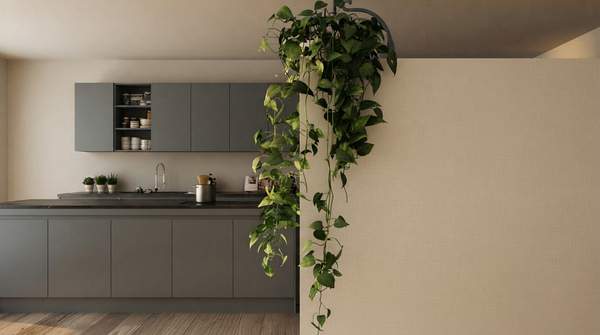
Trailers are the low-effort showstoppers. Give them a perch and gravity does the styling.
- Hanging planters: Sol Soils calls these a great showcase for trailing vines, elevating the plant so leaves cascade gracefully downward.
- Shelf and mantel draping: let vines spill from bookshelves, mantels, or the edge of a sideboard.
- Curtain effects: Perrone suggests mounting a shelf above a door or securing a bar across a window to hang pots, creating strands that fall like a living curtain.
- Drift-and-drape: for pothos, guide stems over and around frames or railings — the plant handles the rest, producing leafy vines that can reach up to 10 feet indoors, according to the Yahoo Shopping piece.
Perrone's maintenance tip applies doubly here: vines hanging near a bathroom or kitchen sink often do best, because you see them daily and catch problems early.
Decision Framework: Climbing vs. Trailing Vines
Use this matrix before you shop. Match your space, your aesthetic goal, and your willingness to train against each row — whichever column fits most of your answers is your plant type.
| Characteristic | Climbing Vines | Trailing Vines |
|---|---|---|
| Growth habit | Grow upward; can be trained to adhere to structures, ideally starting when young | Grow downward from the container; stems cannot hold themselves up without guidance |
| Aesthetic effect | Vertical garden or green wall — foliage climbing a pole, trellis, or wall | Cascading curtain of foliage that softens a room |
| Required display/support | Needs a support: moss or coir pole, trellis, stakes, ring trellis, or wall hooks and clips | Best in hanging planters or draped from shelves and mantels; no training needed for the classic look |
| Training effort | Higher — most need help to cling, so you'll tie or clip stems as they grow | Lower — allow to hang freely; optional draping over frames or railings |
| Maintenance effort | Both need regular pruning to keep their shape and grow full rather than sparse — plus seasonal watering adjustments | |
The comparison reveals the core trade-off: climbers buy you vertical drama at the cost of ongoing guidance, while trailers deliver effortless softness but demand floor, shelf, or ceiling space below them. Either way, maintenance is the same — prune consistently.
Essential Maintenance: Pruning for Fuller Growth and Health
This is where most vine owners go wrong. Left alone, indoor vines get long, sparse, and shapeless.
Horticulturist Doug Jimerson of Costa Farms describes the problem vividly: vining plants like pothos and philodendron, when grown indoors, "have a tendency to throw out long tendrils that loop around without any shape or form." His fix: keep trimming them back to promote more compact, lusher growth. The plants look better — and you won't have to drape stray stems around your home.
Your pruning routine:
- Pinch out growing tips during the growing season. Perrone advises this directly for leggy plants — it keeps them bushy.
- Routinely pinch back leaves on plants like pothos, which Ted Lare's guidance says prevents the plant from becoming thin and lanky.
- Remove dead, damaged, or diseased foliage as soon as you notice it, per Sol Soils.
- Trim long vines to maintain your desired length and shape.
Pruning isn't a rescue operation — it's routine upkeep that maintains shape and promotes thicker, healthier growth.
Beyond Pruning: Watering and Light for Lush Vines
Pruning shapes the plant; watering keeps it alive.
- The golden rule: let the top inch of soil dry out before watering again, per Sol Soils' guidance.
- When in doubt, underwater. Overwatering is the common mistake, and watering less often is usually the safer bet.
- Adjust with the seasons. Most plants need more water in spring and summer — the growing season — and less in fall and winter, when many go dormant.
Light matters for placement, too. Pothos tolerates low-light conditions, making it a go-to vine for dim homes, according to the Yahoo Shopping roundup. Gardenista and Sol Soils both emphasize that light access should factor into where you install any vine display.
Cultivating Your Ideal Indoor Vine Aesthetic
The decision: choose a climbing vine if you want vertical structure and will commit to tying, clipping, and training — choose a trailing vine if you want cascading softness with minimal hands-on work. Then apply the matching techniques: moss poles, trellises, and wall hooks for climbers; hanging baskets and shelf draping for trailers. In both cases, prune during the growing season and water according to the soil's dryness and the season.
Here's your measurable indicator of success: the plant exhibits new, healthy growth in the desired direction — upward for climbers, cascading for trailers — and maintains a full, bushy appearance rather than becoming sparse. If stems start looping aimlessly or thinning out, that's your signal to pinch back the growing tips and get the vine back on track.
Sources
- Climbing Houseplants & How To Train Them — Ted Lare - Design & Build
- 16 Vining Plants to Bring a Natural, Lush Look to Your Home’s Indoor Spaces — Yahoo Shopping
- Everything You Need to Know About Houseplant Vines - Gardenista
- Indoor Vining Plants: Enhance Your Space — Sol Soils
- Houseplants That Climb and Trail — Costa Farms