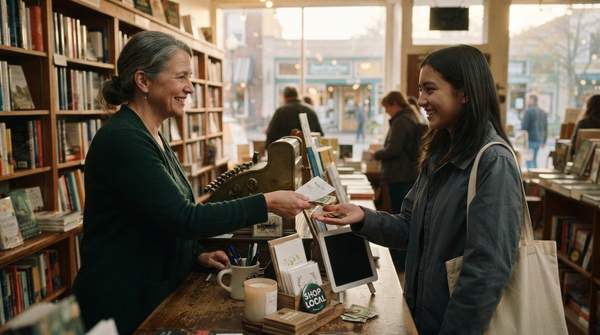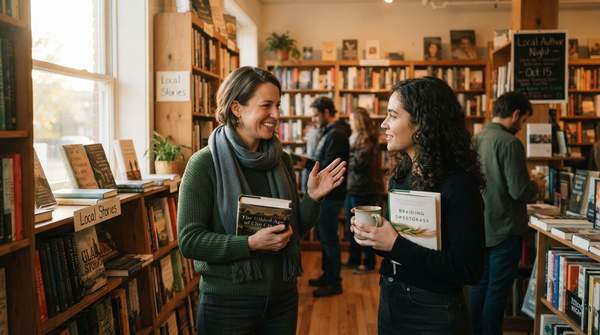
Independent bookstores stand apart from chains and online retailers in three connected ways: they curate their shelves for discovery rather than stocking sheer volume, they act as gathering places that host events and build local culture, and they recirculate a far larger share of your spending within the community. A Harvard Business School study of the sector distilled the formula into competing on experience and quality rather than price and inventory, and establishing the store as a gathering place through events tailored to local tastes. Together, those elements create an experience that large retailers have struggled to replicate.
The Unique Charm of Independent Bookstores
An independent bookstore is a locally owned business, distinct from national chains and online platforms in both structure and spirit. Writing for New Harbinger Publications, publisher Catharine Meyers argues that indies matter because they foster community, offer personalized recommendations, and create spaces for meaningful discovery. Unlike larger retailers, she writes, they connect readers with books through human relationships, curated selections, and local engagement—making reading a shared, not just solitary, experience.
That framing is not just sentiment. The Harvard study's recommendations to booksellers were to communicate the value of community, encourage customers to participate in a broader shop-local movement, and compete primarily on experience and quality. In other words, the sector's own playbook leans on exactly the qualities chains find hardest to copy: relationships, place, and personality.
Curation: The Art of Discovery
Walk into an indie with a specific title in mind and you will likely leave with something you never considered, as one Libro.fm writer puts it: browsing the shelves turns up books an online search would not. That distinct character, she argues, provides an experience online shopping cannot match. The point is not that indies carry more titles—they carry fewer, chosen deliberately for the neighborhood they serve.
Staff expertise is the engine of that discovery. Rebecca George, owner of Volumes Bookcafe in Chicago's Wicker Park neighborhood, described the personal touch in an interview with IBPA PubSpot: "I've been known to email a specific customer about a book that is forthcoming that I know they would love. And they get it!" That kind of relationship—where a bookseller knows your taste and reaches out—simply has no equivalent in a transactional, algorithm-driven storefront.
Community Hubs: More Than Just Books
Beyond retail, independent bookstores function as what sociologists call a "third place"—somewhere between home and work where people connect. The evidence is concrete: author signings, book club meetings, workshops, game nights, story time for children, and partnerships with schools and libraries on literacy programs. Writing in the Stanford Social Innovation Review, Barbara Wheeler and William Ames describe families returning for author events, workshops, and game nights alongside longtime residents, with the bookstore becoming "a common place where new relationships form across walks of life."
Many indies add cafés and seating, which turns a quick errand into a lingering visit. The Harvard study's advice to booksellers—offer events that consumers view as unique experiences, catering to local tastes—captures why this works: the calendar reflects the specific community, not a corporate template. Following your local store on social media is the simplest way to find out what is happening.
Independent vs. Chain/Online Bookstores: A Comparison
The three pillars above come into sharpest focus when placed side by side with the chain and online model. The table below contrasts the two across the dimensions that matter most to a reader deciding where to buy.
| Characteristic | Independent Bookstore | Large Chain / Online Retailer |
|---|---|---|
| Book selection | Curated, often specialized inventory chosen for the local community, leading to unique discovery | Large, high-volume inventory selected centrally, driven by scale and algorithms |
| Staff expertise | Personalized recommendations from knowledgeable staff who know individual customers | Transactional service; recommendations generated by algorithms rather than relationships |
| Community role | Gathering place and intellectual center hosting author events, book clubs, workshops, and game nights | Retail space focused on sales, without a local events calendar rooted in the neighborhood |
| Local economic impact | Recirculates a substantially larger share of revenue locally, supporting local jobs and entrepreneurs | A much smaller share of each purchase stays in the local community |
The pattern across every row is the same: the indie model trades volume and price for relationships, place, and local circulation. That trade-off is the reader's real decision.
Local Economic Impact: Investing in Your Neighborhood
The shop-local argument rests on measurable multiplier effects. According to figures cited by American Express and reported by Libro.fm, for every dollar spent at a U.S. small business, about 67 cents stays in the local community, versus 45 cents at a big box store such as Barnes & Noble or Books-A-Million. That recirculation supports local jobs and entrepreneurs.
Bookstore-specific research points the same direction. A study by Civic Economics and the American Booksellers Association, cited by Wheeler and Ames, found that independent bookstores recirculate approximately 29 percent of their revenue locally through wages and purchasing—more than double the rate of chain retailers. An earlier Civic Economics case study in Austin, Texas, reported by the Institute for Local Self-Reliance, found that $100 spent at a locally owned book or record store generated $45 of local economic activity, versus $13 at the chain Borders Books & Music. Reviews of Civic Economics studies summarized by Reclaim Democracy! found that on average 48 percent of each purchase at local independent businesses was recirculated locally, compared to less than 14 percent at chains.
Indies also pull dollars toward the whole district. Wheeler and Ames note that customers who come for books or events often stay to visit nearby shops, restaurants, and cafés, contributing to the broader vitality of Main Streets.
Supporting Your Local Independent Bookstore
Choose independent bookstores for a unique experience that fosters community, offers curated discovery, and strengthens the local economy. The evidence supports all three: personalized recommendations and curated shelves make reading a shared experience, events build local culture and connection, and a substantially larger share of every dollar you spend stays in your community.
You do not need a special occasion to act on that choice—Meyers notes that supporting local bookstores can be part of everyday habits, and Libro.fm suggests simply following your store on social media to keep up with events. The measurable indicators of your impact are visible: increased attendance at local bookstore events, personalized recommendations from staff who learn your taste, and a vibrant local business district where the bookstore anchors nearby shops and cafés. Watch for those signs in your own neighborhood, and you will see the framework working where you live.
Sources
- HBS
- Why Independent Bookstores Still Matter — New Harbinger Publications, Inc
- Why Shop Local at an Independent Bookstore? — Libro.fm Audiobooks
- The Essential Role of Indie Bookstores — IBPA PubSpot
- Sustaining Independent Bookstores (SSIR)
- The Multiplier Effect of Local Independent Business ⋆ Reclaim Democracy!