Every city seems to have one: the dish that shows up on postcards, in festival posters, and in arguments about where to find the best version. But nothing is born iconic. A local food earns that standing through a describable cultural process — one that culinary anthropology helps us name. The key distinction, as the field draws it, is between traditional food, which is inherited orally within families and communities as part of their identity, and typical or "popular" food, which most people in a place like and which is massively replicated. A dish becomes a city's icon by traveling the full distance from the first category to the second — and then a step further, into a symbol of the place itself.
From Family Recipe to City Symbol: The Journey of an Iconic Dish
Food writers who have traced the phenomenon tend to describe it the same way. Writing for PA Eats, Emily Kovach observed that "every city has its food love affairs, that dish or snack that becomes so fused with the area's identity, that it's often used as a symbol of that place" — cheesesteaks in Philadelphia, bagels and pizza in New York, crab cakes in Baltimore. What that framing captures is the endpoint of the process. The question is how a dish gets there, and the answer begins with inheritance rather than invention.
Most traditional dishes, according to the anthropological account, originate from the creativity of home cooks who combined the techniques and ingredients they had on hand. If people like the result, it gets imitated — spread and replicated so many times that it becomes a classic recipe, tied to a land of origin, specific products, and specific local habits. Iconization is what happens when that classic escapes its community of origin entirely.
Stage 1: Traditional Roots and Immigrant Origins
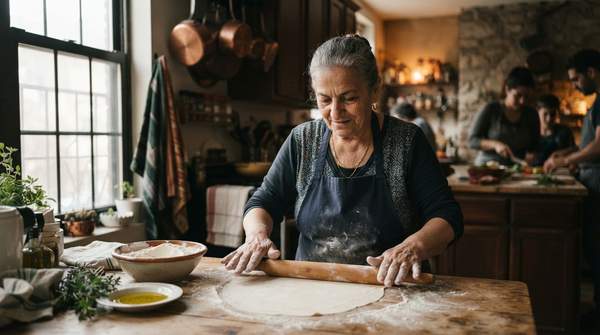
Stage one is small-scale and intimate. A dish is passed down orally, in kitchens, within a family or a community that treats its preparation as part of its culture and identity. This is where heritage dishes usually carry specific techniques — consider how pierogi are made: unleavened wheat dough, rolled flat, cut into circles by pressing with a cup, filled, and sealed, with regional preferences running from potato and cabbage to sour cream garnishes and sweet fruit fillings.
In American cities, stage one frequently arrives via migration. As Upwardly Global's account of immigrant food traditions notes, pierogi were brought to the United States by Eastern European immigrant communities, becoming a staple in cities like Chicago, Cleveland, Detroit, and Pittsburgh. Apple pie followed a parallel path: rooted in English and Dutch baking traditions, carried by European settlers, and adapted to America's abundance of apples before being recast as a classic American recipe. The dish arrives already traditional; the new land supplies the audience.
Stage 2: Community Adoption and Widespread Replication
Stage two is where the dish first moves beyond the household. Replication is the mechanism: a recipe is imitated, shared, and reproduced until it becomes a classic. In Polish-American communities, this happened through family tables and communal occasions — pierogi became a family food, and families commonly make them together at Christmas. Community gatherings then widened the circle, with pierogi served at church events and fundraisers across Polish-American neighborhoods.
The replication stage matters because it is where taste meets memory. As a food bank piece on food and culture puts it, food customs are important not only for preserving cultural identity but also for promoting understanding between cultures — food serves as a bridge. A congregation eating pierogi at a parish fundraiser is doing something more than eating: it is rehearsing a tradition in front of neighbors.
Stage 3: Becoming 'Typical' and a Local Staple
Stage three is the pivot from traditional to typical — and it is the step people most often miss. A typical dish is one most people in a place like and that is massively replicated, regardless of whether its history is widely known. A traditional dish may become typical, but not all traditional dishes do, and not all typical dishes are traditional. The clearest marker of the transition is commercial availability outside the founding community: by the 1960s, pierogi were a common supermarket item in the frozen food aisles of many parts of the United States and Canada, and they remain in grocery stores today.
Adaptation accelerates the shift. The North American pierogi tradition has absorbed fillings like jalapeño, chicken, spinach, and cheddar — contributions that no Eastern European grandmother would recognize, but that helped the dumpling find a place on restaurant menus across the continent. The original tradition survives; it simply stops being the whole story.
Stage 4: Achieving Iconic Status as a Cultural Symbol
The final stage is symbolic fusion. The dish stops being merely popular and starts standing for the place itself — used in marketing, in festivals, in civic self-description. Pierogi illustrate it precisely: they have become a symbol of Polish-American cultural identity, and towns with Central and Eastern European heritage celebrate them openly, from Whiting, Indiana's annual Pierogi Fest each July to Cleveland's Slavic Village Pierogi Dash to Pittsburgh's own pierogi festivities, where the dumplings even feature in mascot races.
The telltale sign is when newcomers feel obligated to engage. A Pittsburgh restaurateur told PA Eats, "I fought for putting pierogies on the menu when we first opened up, because we are in a pierogi city!" — a sentence that only makes sense when the dish has become shorthand for the city's identity.
The Four Stages of Culinary Iconization
Drawn together, the evidence describes a repeatable pattern. Each stage below is defined by the anthropological distinction between traditional and typical cuisine, illustrated by pierogi's path through Pittsburgh and its sister cities, with the driving factors noted alongside.
| Stage / Factor | What Happens | Pierogi Example |
|---|---|---|
| Stage 1: Traditional Origin | A dish is inherited orally, at small family scale and larger community scale, as part of a culture's identity; classic recipes begin as home cooks combining available ingredients. | Pierogi made from rolled wheat dough, filled and sealed by hand, passed down in Eastern European families. |
| Key Factor: Immigrant Introduction | Migrants carry a traditional dish to a new region, where it takes root. | Eastern European immigrants established pierogi in Chicago, Cleveland, Detroit, and Pittsburgh. |
| Stage 2: Community Adoption & Replication | A well-liked recipe is imitated and spread until it becomes a classic; communal settings widen the audience. | Pierogi served at church events and fundraisers and made by families together at Christmas. |
| Stage 3: Becoming 'Typical' | The dish shifts from traditional to typical: what most locals like and massively replicate, often without knowing its history, aided by commercialization. | By the 1960s, pierogi were common in U.S. and Canadian supermarket frozen aisles. |
| Key Factor: Cultural Adaptation | The dish bends to local ingredients and tastes, broadening appeal. | North American fillings like jalapeño, chicken, spinach, and cheddar. |
| Stage 4: Iconic Status | The dish fuses with a place's identity and is used as its symbol. | Pierogi in Pittsburgh mascot races, Whiting's Pierogi Fest, Cleveland's Pierogi Dash. |
| Key Factor: Community Identity | Food customs perpetuate cultural identity and can bridge cultures; shared presence in local life cements the symbolic association. | Pierogi as a recognized symbol of Polish-American identity. |
The model's value is diagnostic rather than historical: to read any local dish's position, ask whether it is still family-bound, whether it is being replicated beyond its founding community, whether most people in the region now eat it, and whether the city uses it to represent itself. The same questions that explain pierogi apply to carne guisada in San Antonio or crab cakes in Baltimore.
Recognizing a City's Next Culinary Icon
To identify a city's next iconic dish, look for a food that is deeply rooted in a specific community's tradition, is being replicated and adapted beyond its original group, and is beginning to be claimed as local identity. The measurable indicators are concrete: increased commercial availability of the traditional dish in diverse settings — supermarket shelves, non-specialty restaurant menus — and its appearance in local cultural events and marketing materials. A dish that shows up both in the frozen aisle and on the festival poster has, in effect, announced which stage it has reached.
Sources
- Pittsburgh + Pierogies, A Love Story — PA Eats
- Traditional food - Wikipedia — EN
- A Nation Built on Flavor: How Immigrant Food Shaped American Cuisine — Upwardly Global
- Pierogi - Wikipedia — EN
- How Food Banks Can Honor Cultural Traditions — SLO Food Bank
- History of Polish Perogies in the US, Origins and Methods of Preparation — Grandmas Perogies