Why do people keep looking at things that disturb them? They follow unsettling stories, return to painful memories and sometimes recognise impulses they would rather leave unspoken. For British artist David Higginson, that uneasy fascination is fertile ground for semi-abstract art.
Based in Accrington, Lancashire, Higginson explores the human psyche through paintings and digital creations. His work is particularly concerned with hidden desires, uncertain memories and the contradictions between what people feel and what they reveal. These interests give his art a recognisable purpose: to make difficult aspects of human experience available for reflection.
Where Recognition Gives Way to Uncertainty
Semi-abstract art offers a distinctive way to approach an emotionally complex subject. Recognisable elements can remain within an image, while changes in form, colour and composition leave room for associations that a literal illustration might settle too quickly. The viewer recognises a starting point without receiving a complete explanation.
That openness connects directly with Higginson’s interest in the private self. A person can appear composed while feeling threatened, seek attention while fearing exposure, or experience affection and resentment towards the same person. These tensions often resist the neat labels used in everyday conversation.
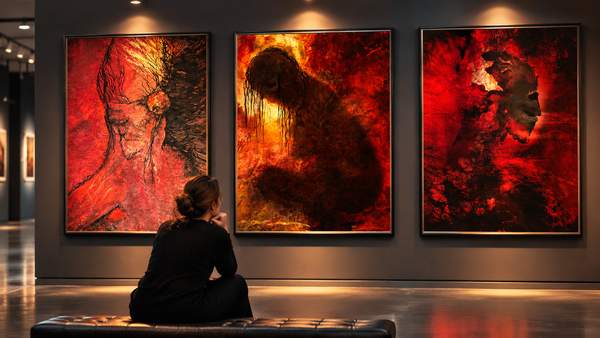
That tension is visible in the work itself. One gallery image places four dark, elongated forms against a turbulent field of teal, pink and burning gold; another centres a glowing figure surrounded by flame-like shapes. Higginson’s stated ambition is to prompt thought and discussion, giving viewers a starting point without prescribing a single response.
The Feelings People Learn to Conceal
Higginson uses the phrase ‘inner demons’ in his artist statement to describe hidden emotions and desires that may emerge under particular circumstances. He is interested in their attractive and repelling qualities, and in how people respond when an uncomfortable feeling becomes difficult to ignore. His subject is therefore as much about human contradiction as it is about darkness.
Concealment has many forms. Someone may hide anger to preserve a relationship, suppress envy because it conflicts with their self-image, or disguise vulnerability behind a confident manner. Such experiences give the artist a broad psychological territory without requiring him to turn each emotion into a fixed symbol.
His approach also raises a question about the stories people tell themselves. If a feeling remains hidden, does it become less influential, or does it continue to shape choices from beneath the surface? The tension between outward conduct and inner experience runs through Higginson’s artistic outlook.
Why Disturbing Stories Hold Our Attention
One of the sharper observations in Higginson’s statement concerns the human attraction to troubling events. He points to the appetite for watching, discussing and documenting tragedy, then asks what motivates that attention. The question has a different force from simply observing that people are interested in dramatic stories.
An unsettling event can provoke compassion and curiosity at once. A person might condemn an act yet continue trying to understand the motives behind it; someone else might recognise a fear they have never experienced directly. That mixture of responses offers an artist more to examine than an uncomplicated division between good and bad.
Higginson’s interest is especially compelling because the person observing a dark subject becomes part of the question. Why did a particular image catch their attention, and what made them linger? His work invites viewers to look at their reactions as well as the subject in front of them.
The darker side of his practice thus carries an element of self-examination. An artwork can open a discussion about moral discomfort, fascination and the limits of empathy without claiming to settle those questions on anyone’s behalf.
Memory and Identity Across the Day Works
Higginson’s documented works Day 1, Day 2 and Day 3 shift the emphasis towards memory and the continuity of personal identity. Their published descriptions associate the pieces with loss of identity, memory loss and a fragmented sense of self. Taken together, they show an artist staying with a subject long enough to approach it from several directions.
Day 1 is catalogued as a digital work concerned with lost identity. Its subject invites a fundamental question: how much of a person’s sense of self rests on their ability to remember people, places and experiences? Memory can connect yesterday’s choices with today’s understanding of who we are.
Day 2 continues the memory-related theme, while Day 3 is described in terms of memory loss and fragmentation. The progression gives the group a tension that a single work could scarcely exhaust. What happens when familiar recollections become less secure, and how might a person make sense of the resulting uncertainty?
The titles give the works an everyday rhythm: a first day, then another, then a third. Against that familiar sequence, the subject of losing memories feels especially unsettling, because ordinary time continues even when someone’s understanding of themselves becomes less secure. Higginson makes the tension between continuity and change part of the artistic inquiry.
Morality and Accountability in The Hangman’s Tree
Memory asks what makes a person feel like themselves; morality asks what that person does with their choices. The Hangman’s Tree, another documented work by Higginson, turns towards accountability and the judgments that surround human behaviour. It expands the concerns of his practice from private experience into the consequences of action.
People can explain their decisions through circumstances, loyalty, fear or necessity. Others may encounter the same behaviour and reach a sharply different judgment, particularly when harm is involved. The gap between an action and the stories told about it gives moral art much of its tension.
Higginson’s interest in inner demons connects these territories. Hidden desires can shape visible conduct, while guilt, self-justification and remorse may follow what someone has done. By giving morality a place alongside memory and emotional concealment, his portfolio presents the psyche as something revealed through both feeling and action.
A Personal Perspective Developed Through Practice
Higginson’s public biography describes art and design studies at Accrington College, followed by fine art studies in Leeds. It also records experience creating commissioned work before he turned further attention towards unfinished projects and independently developed ideas. That background helps explain the breadth of his practice and the persistence of its themes.
His approach is grounded in an ongoing curiosity about people rather than a single fashionable subject. Concealment, memory and morality each open different questions, yet they share an interest in the fragile relationship between inner experience and outward appearance. Together, the works give his artistic identity more substance than a style label alone could provide.
The official gallery presents more than 50 works, offering a broader encounter with that perspective. Viewers can move among individual images and notice which subjects hold their attention, which feel unsettling and which prompt an unexpected personal association. Those responses are part of the dialogue Higginson wants his work to encourage.
Bringing Personal Experience Into a Commission
That interest in interior life also gives context to Higginson’s bespoke artwork service. He offers personalised themes, flexible styles and direct interaction with the person commissioning the piece. A conversation can begin with a memory, relationship or unresolved feeling that someone wants to see interpreted visually.
The appeal of a commission is the chance to bring a subject with personal significance into the creative process. Higginson’s established interests provide a particular artistic perspective, while the commissioner contributes experiences and ideas that are their own. The resulting discussion can give an otherwise private subject a place in an artwork.
Someone drawn to his existing pieces may prefer to encounter them on their own terms, while another person may have a specific idea they want to discuss. Both routes begin with the same invitation to look closely at the emotions and experiences that shape a human life.
Discover the Questions Behind David Higginson’s Art
David Higginson’s semi-abstract work returns to the hidden emotions, changing memories and moral contradictions that make people difficult to understand, even to themselves. Browse his official gallery to discover his artistic perspective, or contact David Higginson to discuss a personalised artwork commission inspired by a subject that has meaning for you.